What This Book Is and Who It’s For
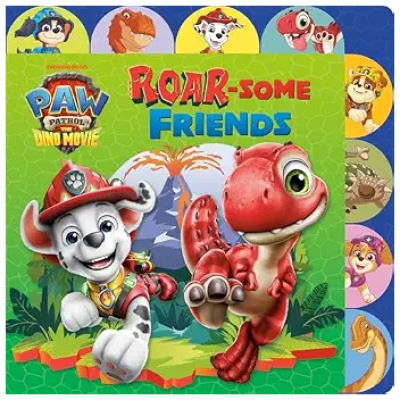
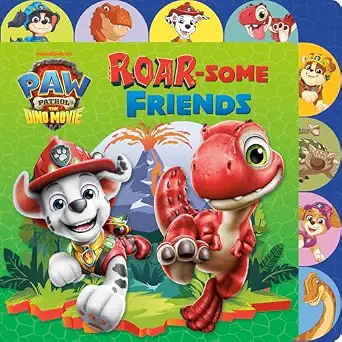
ROAR-some Friends is a board book tie-in to PAW Patrol: The Dino Movie, published by Random House Books for Young Readers on July 7, 2026. It runs 18 pages and is written for a reading age of baby through 3 years, which puts it squarely in the lap-reading and early-independent-page-turning stage rather than the storytime-chapter stage. If you have a toddler who already recognizes Chase and Marshall from the show, or an older sibling who is counting down to the movie, this is a short, sturdy introduction to the film’s characters and world.
The book is a square format, measuring roughly 8.03 by 8.03 inches with a spine thickness of about 0.65 inches, and it weighs around 11.2 ounces. That size matters more than it might sound: a square 8-inch board book is big enough for a child to see the artwork clearly from across a lap, but still small enough for small hands to hold, carry to a parent, and wedge into a diaper bag. The weight comes from the thick pages, which is exactly what you want in a book that will be handled by someone still learning how pages work.
It is written in English and published under ISBN-13 979-8217225392. Parents shopping for a first movie tie-in, a birthday add-on, or a quiet-time book for a child too young for a full picture book will find this fits that gap. It is not a long read, expect a few minutes per sitting, and that brevity is a feature at this age, not a shortcoming.
Design, Format and What’s Inside
The board book format is the defining design choice here. Pages are thick, laminated card rather than paper, so they resist bending, tearing and the general handling that comes with a two-year-old reader. Corners are rounded in the standard board book construction, which reduces the sharp-edge problem that paper picture books have when a toddler is turning pages quickly or holding the book close to their face.
At 18 pages, the pacing is deliberately simple. Board books at this length typically pair one clear illustration per spread with a short line or two of text, which is the format that works for a child whose attention span is measured in seconds rather than minutes. The square 8-inch trim gives the artwork room to breathe, characters can be shown at a readable scale rather than crowded into a small page, and it lays reasonably flat when opened, which helps when a child wants to look at a page on the floor rather than in a lap.
The content centers on the friendships and the dinosaur element that the movie is built around. That means the pages introduce characters and relationships in a way a very young reader can follow through pictures alone, before they can follow a plot. For a toddler, recognizing a familiar pup on the page is the whole event, and the design supports that recognition-first approach.
How Families Actually Use It
The practical use case for a book like this is repetition. Toddlers do not read a board book once; they read it forty times, and they want the same one. An 18-page book is short enough to reread at bedtime without stretching the routine, and short enough that a child can eventually “read” it back to you from memory, an early literacy milestone that happens naturally with books this length.
It also works as an independent-play object. Because the pages survive handling, you can hand it to a child in a car seat, a stroller, or a waiting room without supervising every page turn. Many parents keep one board book in the diaper bag specifically for this; the 8-inch square shape and 11.2-ounce weight make it a reasonable candidate for that rotation, though it is on the larger side of board books rather than the pocket-sized end.
For families going to see PAW Patrol: The Dino Movie, the book has a second use as preparation. Reading it in the weeks before a first cinema trip lets a young child meet the characters and the dinosaur premise in a calm setting, at their own pace, with a parent nearby to answer questions. That familiarity often makes a big dark theater less overwhelming. Afterward, the same book becomes a way to revisit what they saw, a young child who cannot yet retell a story can still point at a page and tell you who that is.
It also pairs naturally with toys. If a child already has PAW Patrol figures or plush, the book gives their play a reference point: the pups on the page and the pups on the rug become the same characters, and that connection is a large part of why licensed board books hold a toddler’s interest longer than generic ones.
Durability, Safety and Age Guidance
The publisher’s stated reading age is baby to 3 years, and the board book construction is what makes that age range workable. Thick card pages do not tear the way paper does, and they tolerate the chewing, bending and dropping that comes with the under-3 crowd. Board books produced by major US publishers are manufactured to the applicable children’s product safety requirements for that age group, including limits on lead and phthalates in inks and coatings, relevant because books in this age band do end up in mouths.
A few practical notes. The laminated surface wipes clean with a slightly damp cloth, which handles the usual sticky fingerprints; avoid soaking it, as water will eventually work into the board edges and cause swelling. Pages can be separated gently if they stick together after a spill. If a corner does get chewed soft over time, that is normal wear for a well-loved board book rather than a defect.
Supervision guidance is the standard advice for this age: a book is not a teething toy, and while board books are built to survive mouthing, they are not designed for sustained chewing. As with any book at this size and weight, keep it off high shelves where a toddler might pull it down. Adult supervision during reading is recommended for children under 3, which is also the age at which shared reading does the most for language development anyway.
Where It Fits in the Paw Patrol Universe
PAW Patrol has worked for more than a decade with the same basic idea: a group of pups with specific jobs, a shared purpose, and a story structure where problems get solved by cooperation rather than conflict. Chase, Marshall, Skye, Rubble, Rocky and Zuma each have a role, and the show’s appeal for parents has always been that the conflict stays gentle and the resolution is always teamwork. That makes the franchise unusually well suited to the toddler age band, where a scary antagonist is a real problem and a helpful-friends story is not.
PAW Patrol: The Dino Movie extends that world into dinosaur territory and brings in new characters alongside the familiar pups. A board book tie-in like this one sits at the entry point of that catalog, it is often the first PAW Patrol item a very young child owns, before figures, before the vehicles, before the longer story books they will grow into at four and five. The title’s focus on friendship is consistent with what the franchise has always emphasized, which is why these books tend to work even for children who have not seen the film.
Within our range, this is the youngest-skewing format we carry for the Dino Movie. Families with children on either side of the age line often end up with a set: a board book for the toddler, a longer picture book or activity book for the older sibling, and figures for both. The shared characters are what makes that work, everyone is looking at the same pups, at the level that suits them.