Building Anticipation: How the Paw Patrol Pop Up Game Brings Adventure Home
When young fans of Adventure Bay’s finest rescue team gather around a table, the energy is already high. The Paw Patrol Pop Up Game by Nickelodeon channels that excitement into a structured, repeatable play experience designed for children aged three and up. Unlike digital alternatives that demand screen time, this physical game offers a tactile, social activity that encourages turn-taking, patience, and fine motor control, all while staying true to the beloved characters children have come to know through the television series.
The game’s premise is straightforward yet engaging: players take turns pressing colorful buttons, each corresponding to a Paw Patrol character. The challenge lies in the unpredictability of the pop-up mechanism. One moment, the game board appears calm; the next, a character springs upward, signaling a change in the round. This element of surprise is central to the game’s appeal, as it mimics the unexpected nature of the rescue missions children watch on screen. The design intentionally avoids complex rules or lengthy setup, making it accessible for younger players who may still be developing their ability to follow multi-step instructions.
From a developmental perspective, the Paw Patrol Pop Up Game serves multiple purposes. The act of pressing buttons strengthens hand-eye coordination and finger dexterity. The requirement to wait for one’s turn fosters impulse control and social awareness. Additionally, the game introduces basic concepts of probability and cause-and-effect: pressing a button may or may not trigger a pop-up, teaching children that outcomes are not always guaranteed. These subtle learning moments are woven seamlessly into the play, ensuring that the primary focus remains on fun rather than instruction.
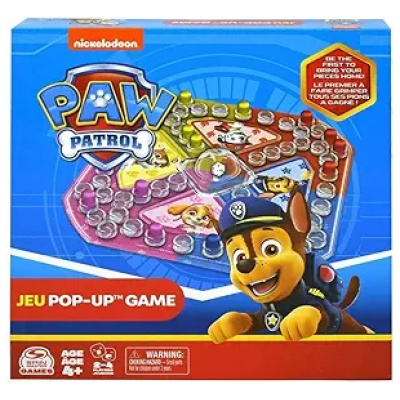
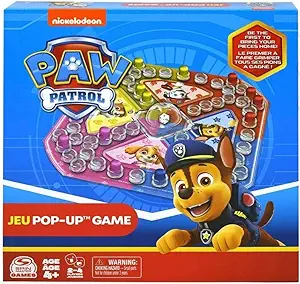
The physical components are designed with durability in mind. The game board features a sturdy plastic construction that can withstand the enthusiastic handling typical of preschool-aged children. The characters are molded from non-toxic materials and are sized appropriately for small hands to grasp. The colors are vibrant and consistent with the show’s palette, Rubble’s yellow, Chase’s blue, Marshall’s red, allowing children to immediately identify their favorite pups. The pop-up mechanism itself is spring-loaded and tested for repeated use, reducing the likelihood of mechanical failure during normal play sessions.
For parents, the game offers a practical solution for indoor entertainment. It requires no batteries, no Wi-Fi connection, and no additional purchases to function. Setup involves simply placing the game board on a flat surface and arranging the character pieces in their designated slots. The entire experience, from opening the box to playing the first round, takes less than two minutes. This low barrier to entry is particularly valuable for caregivers who may be juggling multiple children or managing a busy household schedule.
Understanding the Game Mechanics: What Makes the Pop-Up Action Work
The core mechanism of the Paw Patrol Pop Up Game relies on a spring-loaded platform beneath each character. When a player presses a button, a corresponding plunger is released, potentially causing the character to launch upward. The unpredictability stems from the fact that not every button press results in a pop-up; some buttons are duds, while others are active. This design choice ensures that each round feels fresh, as players cannot predict which character will spring next based on previous actions.
The game accommodates two to four players, making it suitable for small groups or solo play with adult supervision. Each player selects a character pawn, which they move along a simple track on the game board. The track is marked with spaces that correspond to different actions, such as “move ahead one space” or “press a button.” When a player lands on a button space, they must press the corresponding button on the game board. If a character pops up, the player advances; if not, they stay put. The first player to reach the finish line wins.
This structure introduces a light competitive element without being overly aggressive. The emphasis is on participation rather than winning, as the random nature of the pop-ups means that any player can take the lead at any moment. This randomness also prevents older or more experienced players from dominating, leveling the playing field for younger siblings or friends who may be less familiar with strategy-based games.
The character selection includes the main six pups from the series: Chase, Marshall, Skye, Rubble, Rocky, and Zuma. Each character is represented by a small plastic figure that fits snugly into its designated slot. The figures are not interchangeable with other game components, ensuring that children learn to associate each button with a specific character. This association reinforces memory skills, as players must remember which button corresponds to which pup.
The game board itself measures approximately 10 inches by 10 inches, making it compact enough to fit on a coffee table or small play area. The board features a central hub where the pop-up mechanism is housed, surrounded by the track that players navigate. The track is printed with colorful illustrations of Adventure Bay landmarks, such as the Lookout Tower and the Beach, providing visual cues that connect the game to the show’s setting.
Age Appropriateness and Skill Development: What Parents Should Know
The manufacturer recommends the Paw Patrol Pop Up Game for children aged three years and older. This age range is carefully chosen based on the developmental milestones typical of preschoolers. At age three, most children have developed the hand strength and coordination required to press the buttons effectively. They are also beginning to understand the concept of turn-taking, though they may still need gentle reminders from an adult.
The game’s simplicity is a deliberate design choice. There are no written instructions to read, no cards to shuffle, and no scoring system to track. The rules can be explained verbally in under thirty seconds: “Press a button. If a pup pops up, move your piece. If not, it’s the next player’s turn.” This minimal cognitive load allows children to focus on the physical and social aspects of the game rather than struggling to remember complex procedures.
For younger players, the game offers opportunities for language development. As children press buttons, they can name the characters, describe the colors, or narrate the action. An adult can extend this learning by asking questions like, “Which pup do you think will pop up next?” or “What color is Marshall’s uniform?” These interactions build vocabulary and encourage expressive language skills.
Children who are slightly older, around five to six years old, may find the game less challenging but still enjoyable for its social value. At this age, children can begin to understand the probabilistic nature of the pop-up mechanism. They may start to develop simple strategies, such as pressing buttons that have not popped up recently, though the random nature of the game means these strategies are not reliably effective. This introduces the concept of luck versus skill, a distinction that becomes more relevant in later childhood.
The game also supports emotional regulation. When a child presses a button and nothing happens, they experience a mild disappointment. When another child’s press results in a pop-up, they may feel envy or frustration. These moments provide natural opportunities for adults to model appropriate responses, such as saying, “It’s okay, you’ll get another turn soon,” or “Look how happy your friend is, let’s cheer for them.” Over time, repeated exposure to these small emotional challenges helps children build resilience and empathy.
Durability and Safety: Evaluating the Build Quality for Active Play
Parents evaluating toys for young children naturally prioritize safety and durability. The Paw Patrol Pop Up Game is constructed from ABS plastic, a material commonly used in children’s toys for its impact resistance and non-toxic properties. The plastic is free from BPA, phthalates, and lead, meeting the safety standards set by the Consumer Product Safety Commission (CPSC) for toys intended for children under twelve.
The pop-up mechanism is enclosed within the game board, preventing children from accessing the springs or other internal components. The buttons are large enough to be pressed by small fingers but require enough force to prevent accidental activation. This balance ensures that the game remains engaging without being frustratingly difficult to operate.
The character figures are attached to the pop-up platforms via a simple peg-and-socket design. During normal play, the figures remain securely in place. However, if a child applies excessive force or attempts to remove a figure by pulling, the peg may detach. This is a deliberate safety feature: the figures are designed to break away under stress rather than causing injury or damage to the mechanism. If a figure does detach, it can be reattached by aligning the peg with the socket and pressing down firmly.
The game board’s surface is printed with non-toxic inks that resist fading and scratching. The track markings are clear and easy to follow, even after repeated use. The board’s edges are rounded to prevent sharp corners, and the overall weight of the game (approximately 1.5 pounds) makes it easy for a child to carry without risk of dropping or causing injury.
Cleaning the game is straightforward. The plastic surface can be wiped with a damp cloth and mild soap. The character figures can be rinsed under running water if they become sticky or dirty, though they should be dried thoroughly before being stored. The game does not contain any electronic components, so there is no risk of water damage from cleaning.
Storage is facilitated by the game’s compact design. The board and figures fit neatly into the original packaging, which measures approximately 10 inches by 10 inches by 3 inches. This box can be stored on a shelf, in a closet, or under a bed without taking up excessive space. For families with limited storage, the game can also be disassembled by removing the figures and placing them in a separate container.
Integrating the Game into Daily Routines: Practical Tips for Parents
The Paw Patrol Pop Up Game is versatile enough to be used in a variety of settings beyond traditional game night. Its short playtime, typically five to ten minutes per round, makes it an ideal activity for transitions between meals, bath time, or bedtime. A quick game can help a child shift focus from a high-energy activity to a calmer one, providing a structured wind-down period.
For parents of multiple children, the game serves as a tool for teaching cooperation and patience. Because the game requires turn-taking, it naturally encourages children to wait for their turn and respect the play of others. Adults can reinforce these skills by praising positive behavior: “I noticed you waited so patiently for your turn. That was very kind.” Over time, children internalize these social norms and apply them in other contexts, such as sharing toys or waiting in line.
The game can also be adapted for solo play. A child can practice pressing buttons and moving the pawn around the track without opponents. This independent play builds confidence and allows the child to explore the game’s mechanics at their own pace. Parents can use this time to observe their child’s problem-solving approach or to engage in parallel play, where the adult plays their own game nearby.
For families with children of different ages, the game’s simplicity ensures that younger children can participate without feeling overwhelmed, while older children can still find enjoyment in the social interaction. The random nature of the pop-ups prevents older children from dominating, making the game fair for all players. This inclusivity is particularly valuable for families with children who have developmental delays or sensory processing differences, as the game’s predictable structure and lack of time pressure reduce anxiety.
The game also pairs well with other Paw Patrol-themed activities. After playing, children can draw pictures of their favorite characters, act out rescue missions using the figures, or watch an episode of the show. This cross-media engagement reinforces the connection between the game and the broader Paw Patrol universe, deepening the child’s investment in the characters and stories.
For parents who are concerned about screen time, the Paw Patrol Pop Up Game offers a screen-free alternative that still taps into the child’s interest in the show. Unlike digital games that require a tablet or smartphone, this physical game encourages face-to-face interaction, conversation, and shared laughter. These moments of connection are invaluable for building strong parent-child relationships and creating positive memories around play.