What This Book Is and Who It’s For
The Pup That Never Gives Up is a hardcover Little Golden Book tied to PAW Patrol: The Dino Movie, written for children roughly 2 to 5 years old. At 24 pages, it is built to be read start to finish in a single sitting, which makes it a practical fit for bedtime, quiet time after preschool, or a car ride where a short story is more realistic than a chapter book.
The story follows the PAW Patrol pups into the dinosaur adventure that anchors the film, with a focus on persistence, the idea that a pup who keeps trying can get through a hard moment. That theme is carried by pictures and simple sentences rather than long explanations, so a child who cannot read yet still follows what is happening on each page.
This is a good pick for families who already know Chase, Marshall, Skye, Rubble, Rocky and Zuma from the series and want something connected to the new movie. It also works as a first introduction for a younger sibling who has been watching over an older child’s shoulder. Parents buying for a 2-year-old should expect to do the reading aloud; a 4- or 5-year-old may start recognizing repeated words and character names on their own.
Design, Format and Reading Experience
Little Golden Books have used the same physical format for decades, and this title follows it. The book measures about 6.63 by 8 inches with a spine roughly 0.2 inches thick, and it weighs just under 4 ounces. That size is deliberate: small enough for a preschooler to hold open across their lap, light enough to carry in a diaper bag or backpack without adding real weight.
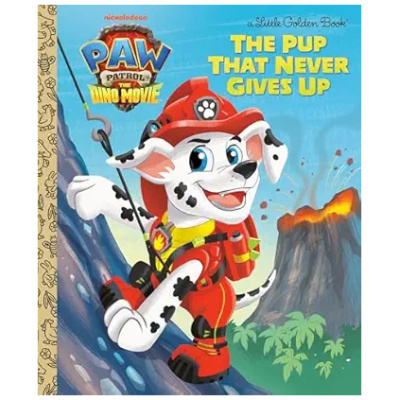
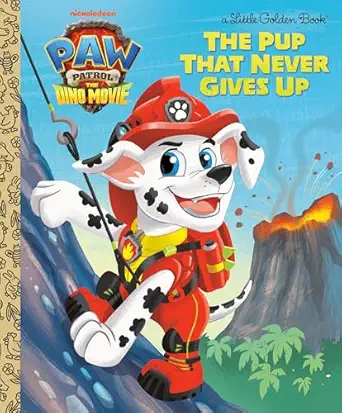
The interior runs 24 pages in English, with full-color illustrations on every spread. Text blocks are short, typically a line or two per page, and sit clear of the artwork so a child’s eye can move between the words and the picture without getting lost. The illustration style matches the movie’s look, so the pups, their gear and the dinosaur elements are recognizable to a child who has seen a trailer or the film itself.
The cover is the standard Little Golden Book hardcover with the gold foil spine, published by Golden Books with a July 7, 2026 publication date and ISBN-13 979-8217124268. The hardcover binding matters more than it sounds: it lets the book stand up on a shelf, survive being pulled off that shelf repeatedly, and stay open flat enough that an adult can read it one-handed while a child points at the pictures.
How Families Actually Use It
A 24-page picture book at this reading level takes about five minutes to read aloud, which is why books like this tend to get read many times rather than once. The repetition is the point for this age group, children ask for the same story night after night, and each pass builds familiarity with the words, the sequence of events and the characters’ names.
Beyond bedtime, the short length makes it usable in situations where attention is limited: waiting rooms, restaurant tables, airplane tray tables, or the twenty minutes before dinner is ready. Because it is a movie tie-in, it also gives you something concrete to do with a child who is excited about a film they have seen once and want to keep talking about.
The persistence theme gives parents an opening for conversation without turning the book into a lesson. A child who is frustrated with a puzzle or a new skill can be reminded of the pup in the story who kept going. Some families use it that way; others just read it as an adventure story, and it works either way.
It is also a reasonable choice for gifting, birthday party favors, Easter baskets, stocking stuffers, or a small item to pair with a plush or toy vehicle. The format is standard enough that many families already own several, and adding a movie title to a shelf of Little Golden Books tends to be welcome rather than redundant.
Durability, Safety and Age Guidance
The publisher’s stated reading age is 2 to 5 years. That range reflects comprehension and interest rather than a strict cutoff, a 6-year-old who loves the franchise will still enjoy it, and an 18-month-old can look at the pictures with an adult, though they will not follow the story.
Parents of children at the younger end should know what a hardcover picture book is and is not. This is a paper-page book, not a board book, so pages can be creased or torn by a toddler handling it alone. The hardcover boards and stitched-and-glued binding hold up well to normal daily reading and to being packed in a bag, but supervised handling is the realistic expectation until a child has learned to turn pages carefully.
There are no small detachable parts, no batteries, no sound module and no pop-up mechanisms, it is simply a printed book, which removes most of the safety questions that come with interactive titles. Standard children’s book printing inks are used. As with any paper product, keep it away from water and be prepared for the occasional taped page, which is a normal part of a well-loved book’s life rather than a defect.
If you want something a younger toddler can handle unsupervised, a board book edition is the better format; if you want something that lasts on a shelf and gets handed down to a younger sibling, this hardcover is the more durable long-term choice.
Where It Fits in the Paw Patrol World
PAW Patrol has been built around a consistent idea since the beginning: a team of pups with distinct jobs, distinct vehicles and distinct personalities, working together on a problem that one of them could not solve alone. Chase handles police and traffic work, Marshall covers fire and medical, Skye flies, Rubble digs, Rocky recycles and repairs, Zuma handles water rescue, and children learn those roles quickly because they are reinforced in every episode.
The Dino Movie extends that structure into a dinosaur setting, which is a natural pairing for the 2-to-5 age group; dinosaurs and rescue vehicles are two of the most reliable interests at that age. This book brings the movie’s story into a format a preschooler can hold, revisit and eventually retell, which is something a single trip to the theater does not do.
Within a family’s collection, it sits alongside the toys, plush pups and dress-up gear as a quieter option, the thing you reach for when the vehicles get put away. Children who own the figures often act out the story afterward, and the book gives that play a shape to follow. For parents building out a shelf of franchise titles, a Little Golden Book edition is the version most likely to still be in usable condition years later, which is part of why the format has stayed in print as long as it has.