What This Game Is and Who It’s For
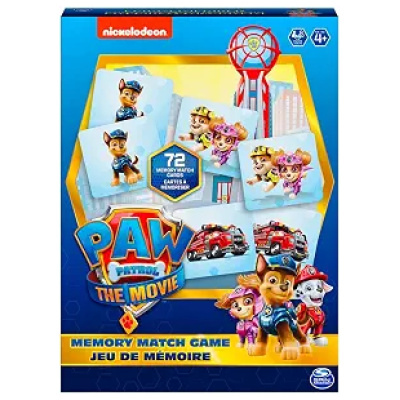
This is a classic memory matching game built around PAW Patrol: The Movie, the big-screen adventure that takes the pups from Adventure Bay to Adventure City. The set contains a deck of illustrated cards that get laid face down on a table or floor. Players take turns flipping two cards at a time, trying to find pairs that match. When a player finds a match, they keep the pair and take another turn. When the cards don’t match, they get turned back over and play passes to the next person. Whoever collects the most pairs by the end wins.
The game is recommended for ages 4 and up, and that recommendation is a fair one. Four-year-olds who already recognize the pups by name can usually pick up the rules within a round or two, and the visual nature of the game means no reading is required. That makes it accessible to pre-readers and early readers alike, which is often the sticking point with other family games at this age. Older kids in the 5 to 8 range tend to play it faster and more competitively, and many parents find that the game scales naturally as a child’s recall improves.
It’s a good fit for households where a parent or older sibling wants to play alongside a younger child. Memory games are one of the few formats where a preschooler can genuinely beat an adult, because visual recall of a small grid is a skill that develops early and doesn’t depend on strategy or vocabulary. That levels the playing field in a way most family games can’t, and it means the younger player stays engaged rather than losing every round.
Cards, Characters, and Design
The card artwork draws from PAW Patrol: The Movie, so the pups appear in their movie-era looks rather than the standard television designs. Chase, Rubble, Rocky, Skye and other members of the team are featured across the deck, along with imagery tied to the film’s Adventure City setting. For kids who have seen the movie, the recognition factor is immediate, and naming the pup on each card often becomes part of the play itself.
Each design in the deck appears exactly twice, which is what makes the matching work. The images are printed at a size and contrast level that reads clearly from across a table, and the pups are distinct enough from one another that a child isn’t left squinting to tell two similar cards apart. That distinction matters more than it sounds, memory games with visually similar cards frustrate younger players, while a deck with clearly different characters and colors keeps the focus on remembering positions rather than deciphering pictures.
The card backs share a single uniform design, so no card can be identified while face down. The deck is compact, which makes the whole game easy to store in a drawer, a tote bag or a backpack side pocket. This is a 2021 release under the PAW Patrol brand, produced as a single-count set with model number 6063219.
How It Plays and What Kids Get Out of It
Setup takes under a minute. Shuffle the cards, lay them face down in a grid, and start flipping. A full game with all the cards in play typically runs 10 to 20 minutes depending on how many people are playing and how quickly matches turn up. For younger children or shorter attention spans, you can pull out half the deck and play with a smaller grid, the game works just as well with 12 or 16 cards as it does with the full set, and shortening it is often the difference between a child finishing a game happily and abandoning it halfway through.
The developmental side is straightforward and well established. Memory matching exercises visual recall, concentration and pattern recognition. Kids practice holding a location in mind while other things happen around them, which is the same working-memory skill that supports early reading and math. Turn-taking is built into the structure, so children get repeated, low-stakes practice at waiting for their turn and handling both winning and losing a round.
Practically speaking, it fills the gaps that come up in family life. It travels well for restaurant waits, road trips, flights and hotel rooms. It works as a quiet activity on a rainy afternoon or as a wind-down before bed. It’s also one of the more reliable screen-free options for kids who are already attached to the PAW Patrol characters, because the familiar faces do a lot of the work in getting a child to sit down and engage in the first place.
The number of players is flexible. Two people can play head to head, and three or four works fine around a table. Some families play cooperatively with very young children, flipping cards together and celebrating each match rather than keeping score, which is a reasonable way to introduce the game to a child on the younger end of the age range.
Materials, Durability and Age Guidance
This is a card game, so the components are printed cardstock. Cards intended for young children are typically made thicker than standard playing cards to hold up to repeated handling, though like any paper-based game they should be kept dry and away from food and drinks. Bent corners are the usual sign of wear over time. Storing the deck in its box between sessions and reminding kids to flip rather than slide cards across a rough surface will extend the life of the set considerably.
On age suitability: the 4-and-up recommendation reflects both the cognitive demands of the game and the physical size of the pieces. Card games are generally not appropriate for children under three, who may still put objects in their mouths, so this set should be kept away from infants and toddlers when older siblings are playing. Adult supervision is sensible for the youngest players in the range, mostly to help with setup and to keep the grid tidy.
Because the game contains no small plastic parts, no batteries and no electronic components, there’s nothing to charge, replace or lose beyond the cards themselves. That simplicity is part of the appeal, it’s ready to play straight out of the box and stays that way. If a card does go missing, the practical fix is to remove its partner from the deck and keep playing with a slightly smaller set, which the game accommodates without any real loss.
Where It Fits in the PAW Patrol World
PAW Patrol is built on a simple, consistent idea: a team of rescue pups, each with a specialty, working together under Ryder to help their community. Chase handles police and traffic work, Marshall covers fire and medical response, Skye flies, Rubble operates construction equipment, Rocky recycles and repurposes, and Zuma takes on water rescues. That structure, everyone contributing something different toward a shared goal, is what makes the franchise land with preschoolers, and it carries into the movie, where the pups relocate to Adventure City and take on a bigger stage.
This game connects to that world through the characters and the film’s visual style rather than through any story-based mechanic. It doesn’t retell the plot or require any knowledge of it. What it does is give kids another way to spend time with characters they already care about, in a format that asks something of them beyond watching. For a child who has seen the movie, spotting a favorite pup mid-flip is a small moment of recognition that keeps them invested in the game.
It also sits well alongside the rest of a PAW Patrol collection. Where the vehicles, figures and plush toys support open-ended and imaginative play, a matching game brings the characters to the table for structured play with rules, turns and a clear ending. Families building out a PAW Patrol shelf often find that the mix matters: something to build with, something to cuddle, and something the whole family can sit down and play together in twenty minutes. This game covers that last category without asking much in the way of space, setup or explanation.