What This Rubble Bulldozer Set Is, and Who It’s For
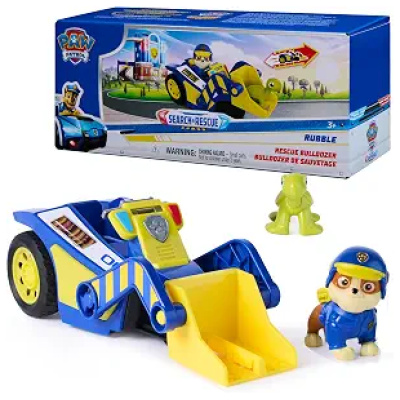
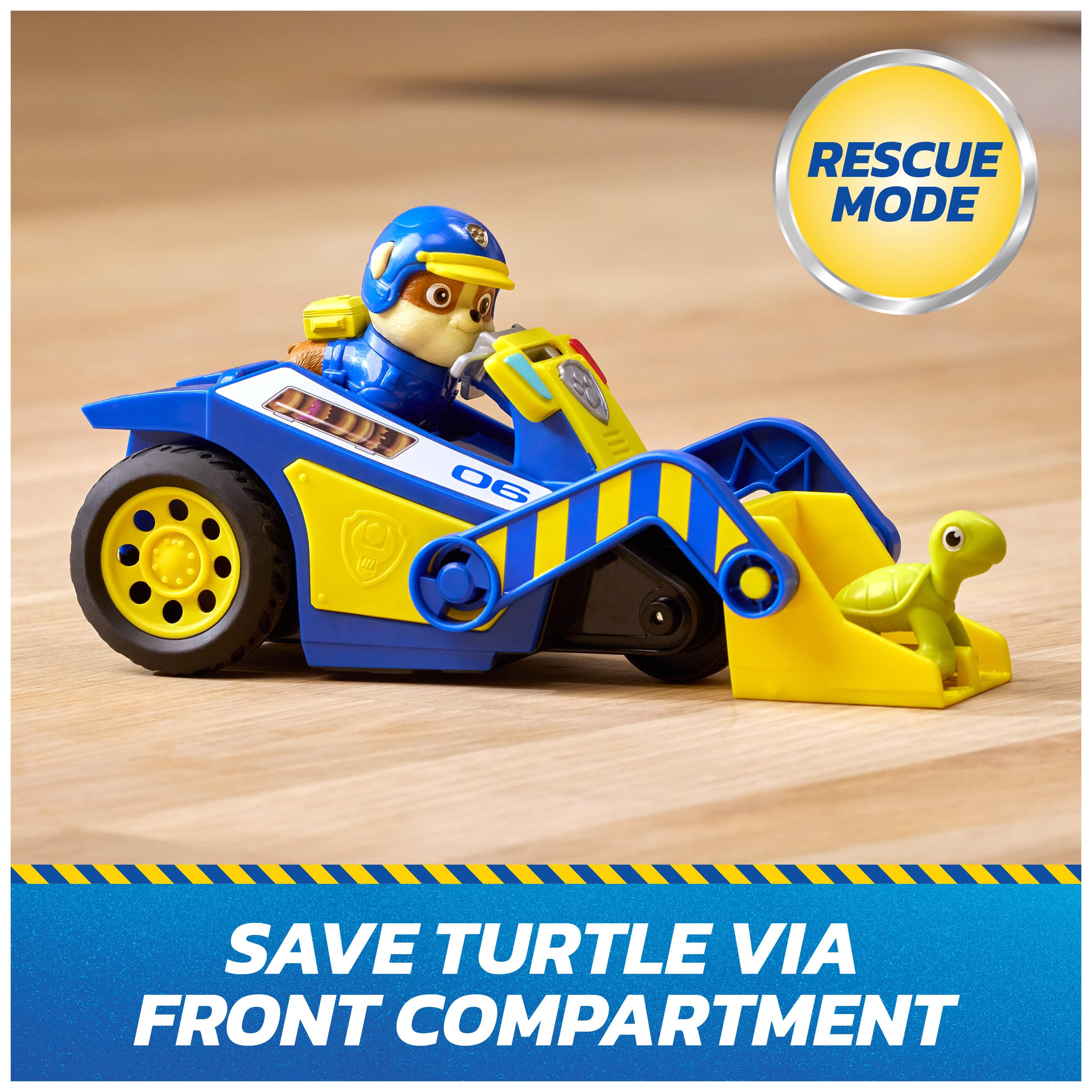
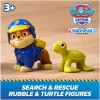
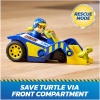
The Paw Patrol Search & Rescue Rubble Bulldozer is a compact pull-back vehicle set built around the show’s construction pup. Three pieces come in the box: the bulldozer itself, a Rubble figure sized to sit at the controls, and a small turtle figure that gives your child someone to rescue. That last piece matters more than it sounds. A vehicle on its own gets pushed across the floor a few times; a vehicle with a pup driving it and an animal waiting to be helped turns into a story, and stories are what bring a toy back out day after day.
It is made for preschoolers and early grade-schoolers, with a manufacturer age range starting at three years and extending through about nine. In practice, the sweet spot is roughly three to six. That is the stretch when children are learning to narrate their own play out loud, when a rescue mission can last twenty minutes, and when a vehicle that moves on its own after a quick push feels like a genuinely satisfying piece of engineering. Older children in the range tend to use it as a supporting piece in a larger collection rather than the centerpiece.
Parents usually reach for a set like this for one of a few reasons: a child has just discovered the show and wants something to hold, a birthday or holiday gift needs to land without a lot of setup, or an existing Paw Patrol collection is missing Rubble specifically. It also works well as a travel toy or a waiting-room distraction, since it is small enough to slip into a bag and needs no batteries, no screen, and no assembly. You open it, hand it over, and play starts immediately.
Design and Features Up Close
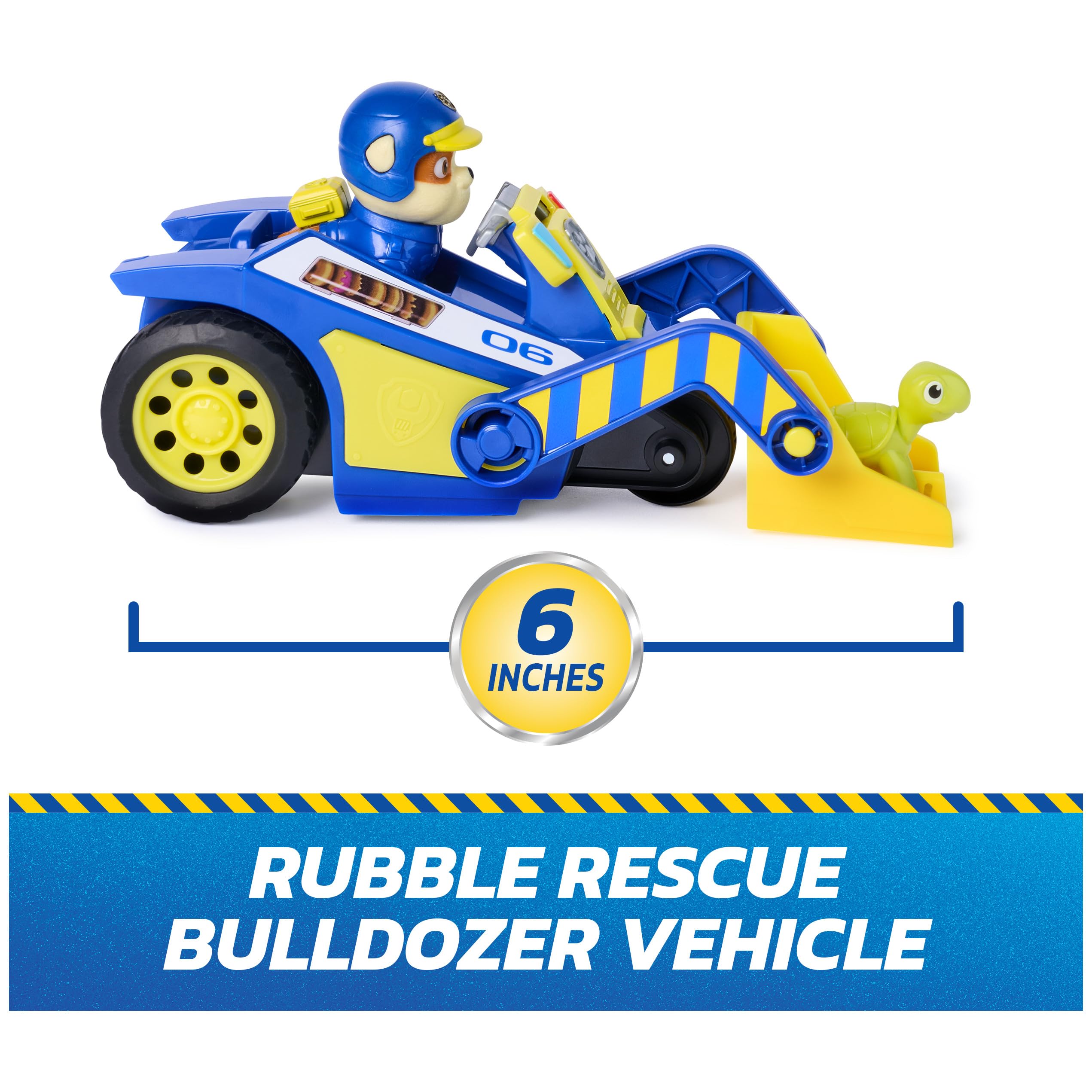
The bulldozer follows Rubble’s construction rig from the series: a broad yellow body, a front blade, and the boxy, sturdy proportions of real earth-moving equipment scaled down for small hands. The detailing is molded and printed rather than sticker-heavy, which means the look holds up after the vehicle has spent a few months getting shoved under couches and carried around in coat pockets. Rubble’s own coloring and gear read clearly at a glance, so children recognize which pup they are holding without needing to be told.
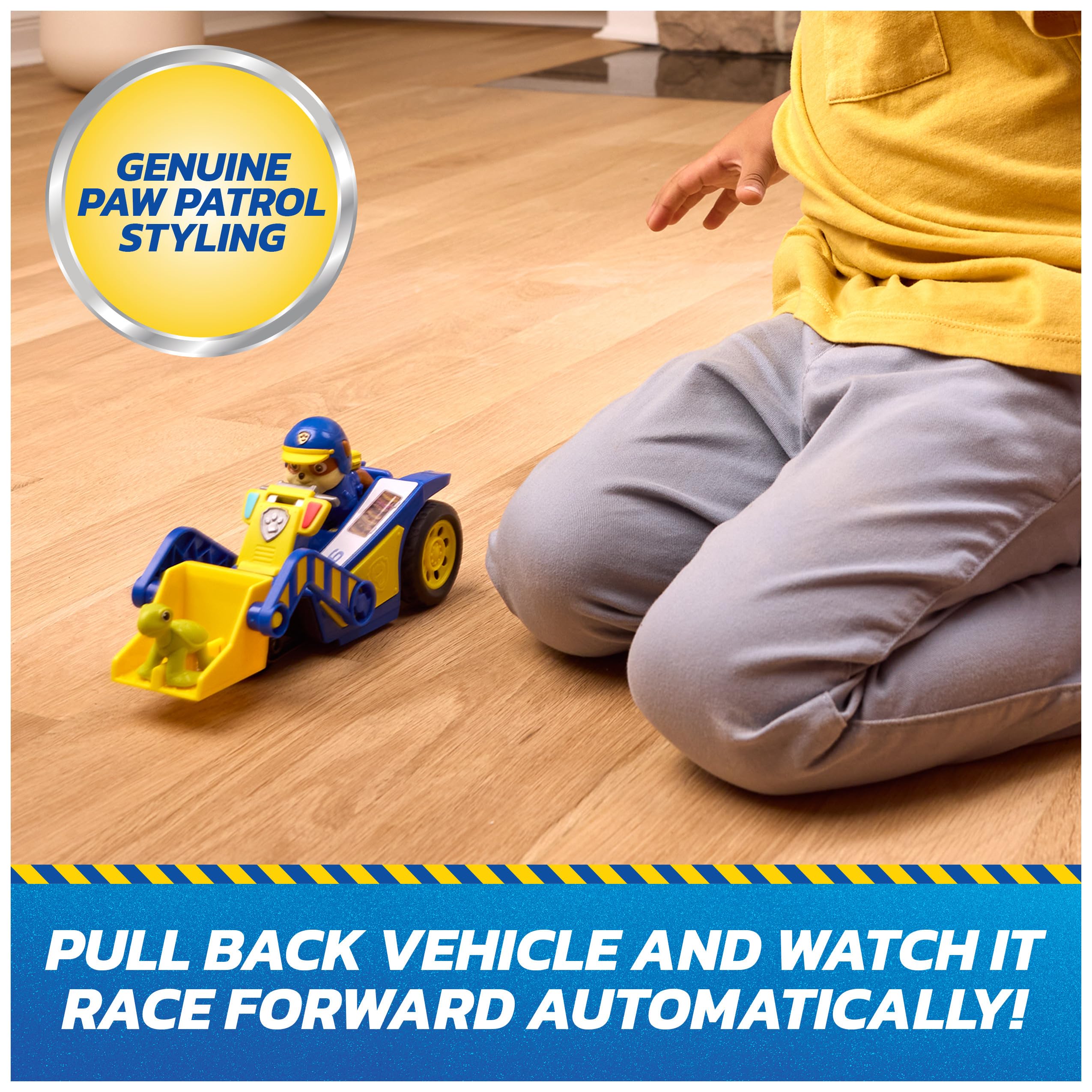
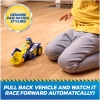
The pull-back motor is the mechanical heart of the toy. Drag the bulldozer backward a few inches along a hard surface, let go, and it rolls forward under its own power. There is no switch, no charging, and nothing to replace when the batteries die, because there are none. The wheels turn freely and independently of the motor, so children can also push the vehicle by hand at whatever speed the story calls for. Hardwood, tile, and low-pile rugs give the best results; deep carpet slows the pull-back mechanism considerably, which is worth knowing before the first attempt.
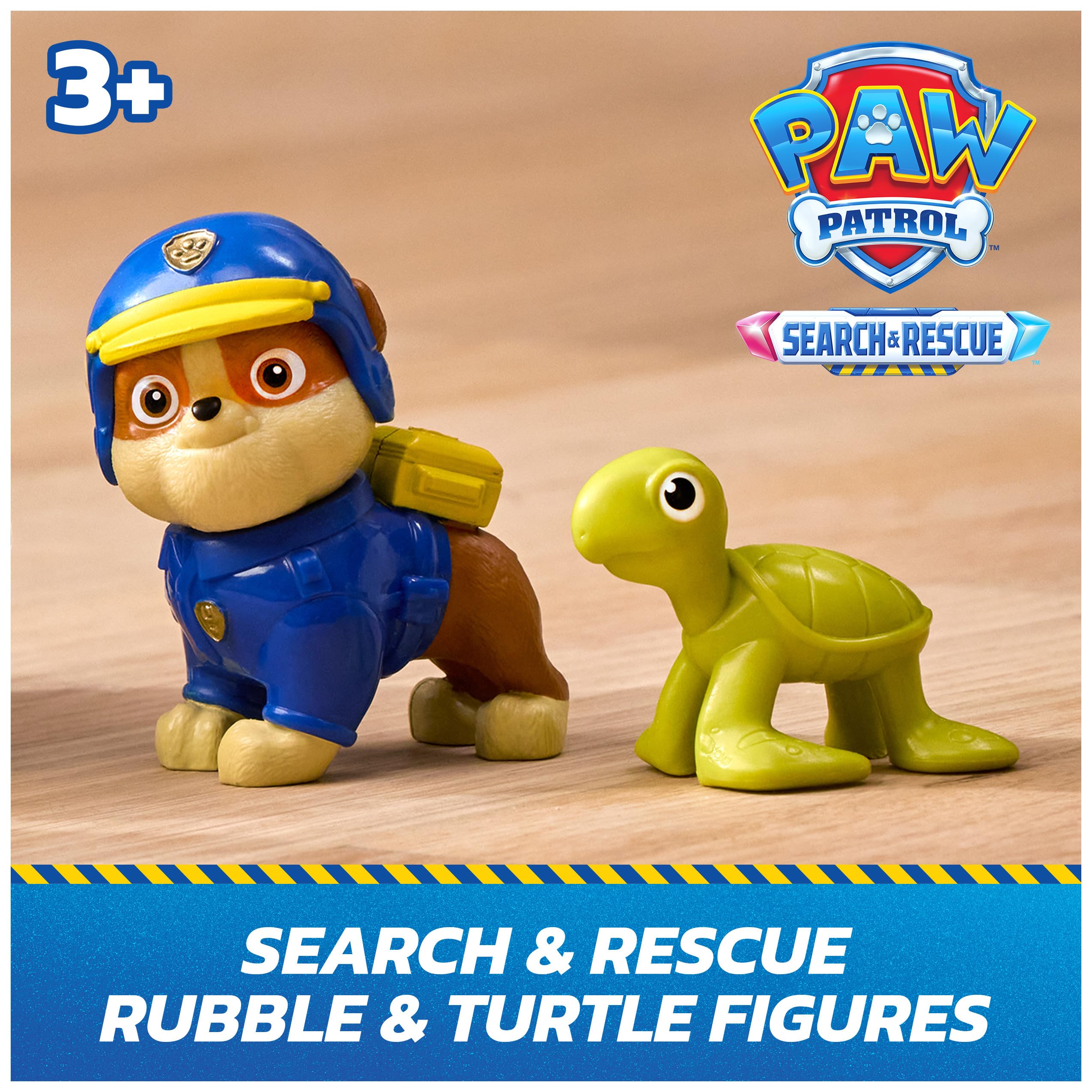
Rubble is a fixed-pose figure rather than an articulated action figure. He seats securely in the cab and lifts out cleanly, which is the right trade-off at this age, a child can move him in and out of the driver’s seat hundreds of times without a joint loosening or a limb snapping off. The turtle figure is a solid molded piece, small and light, and it fits into the play pattern as the animal in trouble. Together the three components make a complete scene straight out of the box, with nothing else required.
How Kids Actually Play With It
The play pattern this set encourages is a simple loop: something is stuck, a pup is called, the vehicle arrives, the animal is freed, everyone goes home. Children repeat that loop with small variations for a surprisingly long time. The turtle gets trapped behind a stack of blocks, then under a cushion, then at the bottom of the stairs. Rubble drives over, clears the way with the blade, and the turtle rides back in the cab. Repetition like this is how preschoolers rehearse cause and effect, sequencing, and the idea that problems have solutions.
The pull-back function adds a physical skill on top of the storytelling. Getting the vehicle to travel where a child wants it to go takes a bit of aiming, a bit of force calibration, and a bit of patience, all of which are genuinely useful motor practice at this age. Children often turn it into an informal experiment without any prompting: how far will it go on the kitchen floor versus the hallway rug, will it climb a book propped against the wall, what happens if two vehicles are launched at each other. None of that needs adult scaffolding, though it is easy to join in when you have five minutes.
It also plays well with other things you probably already own. The bulldozer pushes wooden blocks, plastic animals, cereal, and sand with equal enthusiasm, so it is a natural companion to a block bin or a sandbox. If your household already has other Paw Patrol vehicles, this one slots into the lineup as the heavy-lifting member of the team, and having multiple pups on hand opens up the group-rescue stories that mirror the show’s structure. For a single-child household it stands on its own; for siblings it tends to be one piece in a shared fleet.
Durability, Safety, and Age Notes
The manufacturer sets the minimum age at 36 months, and that number should be treated as a firm floor rather than a suggestion. The turtle figure is small, and both figures are removable, which makes this set unsuitable for children still putting things in their mouths. If you have a toddler in the house alongside an older child, plan on a storage spot the younger sibling cannot reach, a shelf, a lidded bin, or the child’s own bedroom rather than a shared floor basket.
Construction is solid molded plastic throughout, chosen for the kind of handling small children actually deliver: dropped from a table, stepped on, thrown across a room, and taken outside. The pull-back motor is sealed inside the chassis with no user-serviceable parts, so there is nothing a child can pry open. It will collect grit if used in sand or dirt, and the mechanism can get sluggish as a result; keeping outdoor use to grass and pavement, or giving the wheels a wipe afterward, extends its working life noticeably.
Cleaning is straightforward. A damp cloth with a little mild soap handles most of what accumulates, and the vehicle should be dried rather than left to sit wet, since water inside the mechanism is the main thing that shortens it. Avoid the dishwasher and avoid submerging it. The toy is produced by Spin Master, the company that has made Paw Patrol toys since the line began, and it is manufactured to the safety standards required for children’s toys sold in the United States, including limits on small-part hazards for the stated age range.
Why It Fits the Paw Patrol Universe
Rubble is the English Bulldog on the team and the pup children tend to gravitate toward when they like machines. He handles the digging, clearing, and heavy lifting, and his catchphrase energy is less about speed than about getting the job done. A bulldozer is therefore the correct vehicle for him in a way that matters to children, they notice when a character is paired with the wrong gear, and they notice when it is right. Handing a child this set does not require any explanation of who is driving or why.
The Search & Rescue line focuses on the part of the show that resonates most with this age group: the team goes out, someone in trouble gets helped, nothing frightening happens along the way. Including the turtle is a deliberate choice within that framing. The show frequently builds episodes around animals needing assistance, and giving a child the rescued party as an actual object rather than an imagined one lowers the barrier to starting a story. Younger preschoolers in particular do better with a scene they can see than with one they have to invent from scratch.
As part of a broader collection, this set fills a specific slot. If a household already has Chase, Marshall, or Skye, Rubble rounds out the ground-based side of the team and brings the construction play pattern that the others do not cover. If it is a first Paw Patrol purchase, it works as a self-contained introduction, complete with a driver, a mission, and a resolution. Either way it asks nothing of you beyond opening the package, no batteries to source, no instructions to read, no parts to assemble before a child can start playing.